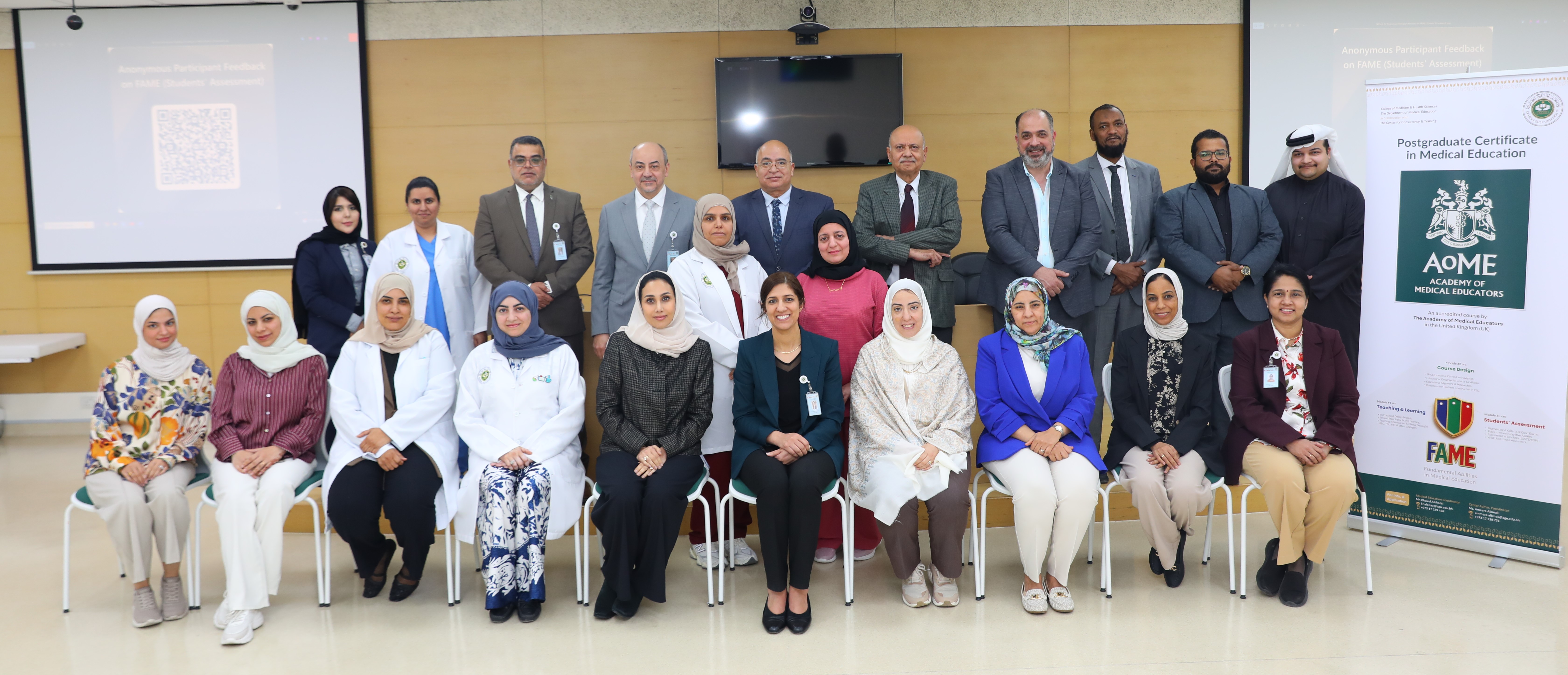
A four-day workshop on “Fundamental Abilities in Medical Education (FAME) Student Assessment,” organized by the Department of Medical Education at the College of Medicine and Health Sciences at Arabian Gulf University, concluded. The workshop was held as
Arabian Gulf University
14 Apr, 2026
A four-day workshop on “Fundamental Abilities in Medical Education (FAME) Student Assessment,” organized by the Department of Medical Education at the College of Medicine and Health Sciences at Arabian Gulf University, concluded. The workshop was held as part of the Fundamental Abilities in Medical Education (FAME) program for academic staff and external health agencies and institutions in the Kingdom of Bahrain.
During the workshop’s opening, Dr. Mohammed Mustafa Al-Iraqi, Head of the Department of Medical Education, emphasized the program’s importance for developing the academic competencies of all healthcare professionals involved in education, training, or supervision, explaining that the workshop aims to enhance their skills in assessing learners, thereby improving the quality of medical and professional education.
The workshop featured interactive sessions that included introductions and an explanation of the scientific rationale for the module, followed by a discussion of the principles, types, and purposes of assessment in medical education, along with a presentation of an updated analytical reading of Miller’s competency assessment pyramid. This was followed by a practical activity to prepare an assessment plan, present the results, and compile the insights gained.
In the second session, the discussion centered on the fundamental criteria governing exam quality, as well as methods for assessing cognitive abilities using various types of multiple-choice questions, extended-response and matching questions, and scenario-based tests, followed by a practical activity to develop these assessment tools and submit detailed reports on them.
In the third session, participants focused on presenting recent trends in assessment and assessment methods in simulation environments such as OSCE and ESPE, followed by the preparation of a model OSCE station, the challenges and lessons learned from which were subsequently discussed. The workshop concluded with a session dedicated to performance evaluation in the workplace, analysis of exam items, and review of results reports, followed by a closing activity during which the course report was prepared and its outcomes were formally presented and discussed.
Participants in the training included Dr. Mohammed Mustafa Al-Iraqi, Head of the Department of Medical Education; Prof. Dr. Hani Salem Atwa from the Department of Medical Education; Dr. Arshana Prabhu Kumar, Associate Professor in the Department of Medical Education; and Dr. Reem Jassim Al-Ansari, Assistant Professor in the Department of Medical Education and Head of theMedical Skills and Simulation Center. The workshop saw remarkable engagement from the participants, who expressed a clear interest in developing or updating their personal and professional skills. They exchanged views on ways to overcome the challenges they might face when applying the approach in medical education, praising the workshop’s rich scientific and practical content.